
What to think about when booking your wedding vendors
The best tips and questions to ask when booking vendors for a wedding in Sweden.
Choosing the people behind your wedding is about more than looking at their beautiful work and finding a good price. It is about knowing what is included, how each person works and whether they feel right for your day. The good news is that with the correct approach, the process in finding your team is easy.
And once you have them, we have listed a few habits which make every conversation easier, for you and for them.
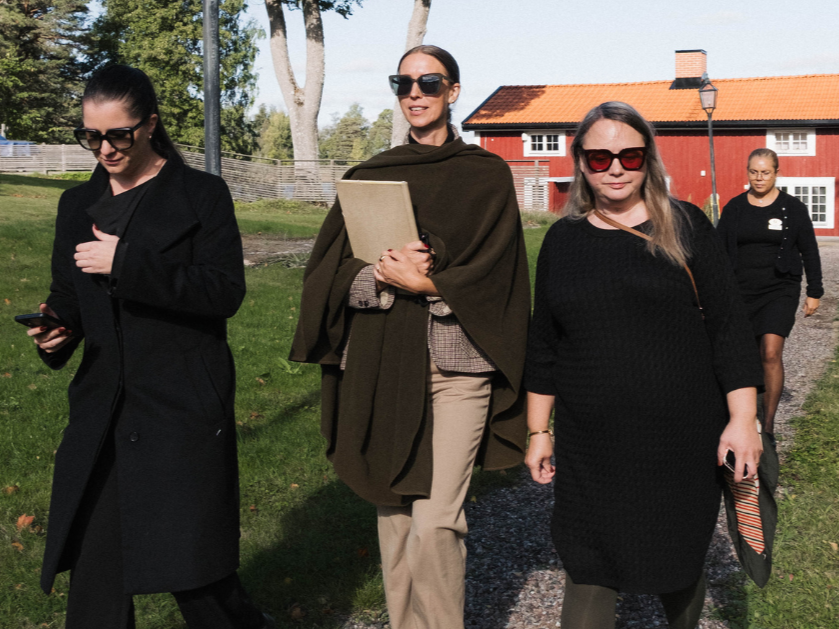
Wedding crew checking out a venue before a wedding. Photo: Birgit Walsh
1. Begin every conversation with the same information
Write one short brief and paste it into every first email to each new vendor you contact. The clearer you are, the better the answer you get back.
Here is the information to always include:
Date (or the months you are considering) and where you will be
How many guests, and what kind: family, friends, children, international guests or a mix
The feeling you want, in a few words: relaxed, elegant, formal, wild, quiet, a crazy big party
Your budget for that vendor, or at least the total you (at this initial point) are willing to spend
Your top three priorities
2. Be clear about your budget from the start
We cannot stress this enough but please be clear about your budget and say what you have in mind. A vendor who knows your number can tell you what is possible and where to spend, instead of sending a quote you cannot use. Being up front with numbers saves everyone time, and it’s only the unetichal professionals who will use the numbers against you to try to max out your budget.
If you’re not sure what a realistic number looks like? Read what a wedding in Sweden costs first.
3. Show what you like, and what you don't
Send photos and a few lines on what you love. Then add what you do not want, for example if there are any colours, styles, things that feel wrong for you. That second list actually saves more time than the first, yet so many forget that part.
One warning: a lot of inspiration online is now made by AI. Flowers, tablescapes and venues that look perfect are sometimes impossible to build in real life, or will cost you a small fortune. Choose photos from real weddings, and ask the vendor straight out: "Is this something you can create?".
Remember that not every inspiration photo has to do with weddings either, look at interior design, architecture, art, natura and fashion too.


Having a moodboard helps a lot in communication with vendors. Photo: Ingrid Tjernström
4. One email thread per topic
Start a new email for a new topic, and keep replying in the same thread for that topic. It keeps everything in one place and makes it easy to find what was agreed.
Put the topic, your names and the date in the subject line: Photography, Anna and Erik, 14 June 2027. Even if your vendors will work with you as you’re the only client, keep in mind that they may get over twenty enquiries with the subject “help for our wedding”.
Ask one question per paragraph, or number your questions so it’s easier to reply to them accordingly.
End with a short summary of what you agreed and what happens next
Copy in your partner or wedding planner, so nothing lives in one inbox. You can also copy important from an email into a document shared with your planner and/or coordinator.
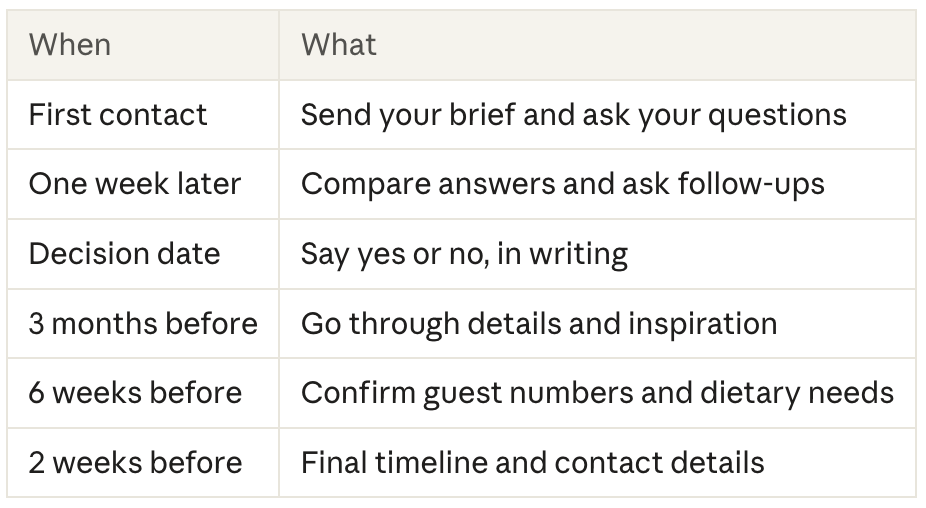
5. Book your check-ins, and decide when you collect information
There are more dates than the wedding day to put in your calendar. Mark out the process with each vendor to make the communication smoother, and the planning much easier.
Keep your questions, the answers and these dates in one shared document or sheet, so you and your partner always see the same thing.
These are things a planner can help you with, or you can also look at our Wedding Planning Checklist.
6. Use our guide as the base for every conversation
We made the Wedding Vendor Conversation Guide to make this easier. It has 225+ questions across 12 supplier types, from venue and photographer to catering, flowers and music, with space for notes. You do not need to ask everything. Pick the five to seven questions that matter most to you for each vendor, and ask the same ones to everyone you compare.
Before you sign anything, check these eight things with every supplier:
The exact services, deliverables and hours
The final price, including VAT (called "‘moms’ in Swedish), travel, staff, rentals and extras
Deposit and payment dates
Cancellation, postponement and refund terms
What happens if the guest count or timing changes significantly
If the vendor has a backup plan in case of something unforseen
Setup, breakdown and access to the venue
Deadlines, which you save in your timeline


7. Always put it in writing
Every vendor needs an agreement, even friends and people recommended to you. A professional will never mind being asked, and if they can’t give you one we would advise you to be careful going forward with a booking. Read why you need written agreements with every vendor.
Want someone to help you choose and keep track?
We match couples with the right wedding planner or coordinator, free of charge. Find your match.
Start with the fixed points, work backwards and add buffers. A simple and near fool proof way to build a timeline everyone can follow.